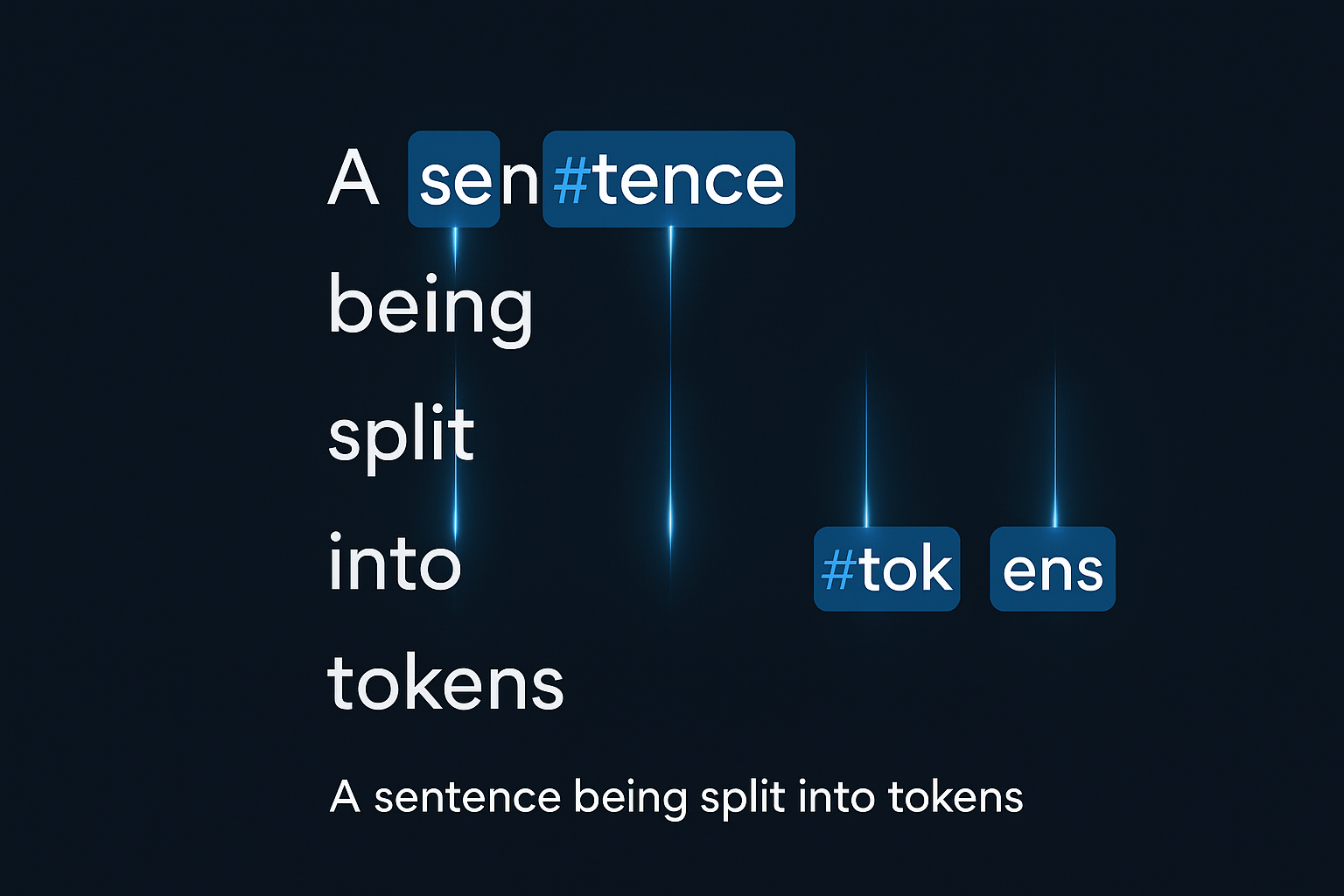
ML models can’t read text - they only understand numbers. So how do we convert “Hello world!” into something a neural network can process? That’s tokenization. It seems simple, but there’s a lot of nuance.
The fundamental question
How do you split "Don't tokenize carelessly!"?
You have several options:
- Character level:
["D", "o", "n", "'", "t", " ", "t", ...] - Word level:
["Don't", "tokenize", "carelessly", "!"] - Subword:
["Don", "'t", "token", "ize", "care", "less", "ly", "!"]
Each approach has tradeoffs. Modern models mostly use subword tokenization - the best of both worlds.
Interactive demo: Tokenization Animation - see how the same text gets split differently.
Character-level tokenization
Every single character becomes its own token.
The good:
- Tiny vocabulary (just letters + punctuation)
- Never see “unknown” words
- Works for any language, even made-up words
The bad:
- Sequences get VERY long (“hello” = 5 tokens)
- Harder for the model to learn word-level meanings
- More computation needed
Rarely used alone nowadays, but some models use it as a fallback.
Word-level tokenization
Split on whitespace and punctuation. The intuitive approach.
text = "Hello, world!"
tokens = text.split()  # ["Hello,", "world!"]
# or with regex
import re
tokens = re.findall(r'\w+|[^\w\s]', text)  # ["Hello", ",", "world", "!"]
Pros:
- Intuitive
- Short sequences
- Each token meaningful
Cons:
- Huge vocabulary (every word form)
- OOV problems (“unbelievable” not in vocab?)
- Morphology issues (run, runs, running = 3 tokens)
Subword tokenization
The sweet spot. Break unknown words into known pieces.
“unhappiness” → [“un”, “happi”, “ness”]
Model can understand new words from known components.
BPE - Byte Pair Encoding
Start with characters. Repeatedly merge most frequent pairs.
Corpus: "low low low lower lowest"

Initial: l o w </w> l o w </w> l o w </w> l o w e r </w> l o w e s t </w>

Iteration 1: merge "l o" → "lo"
Iteration 2: merge "lo w" → "low"
... continue until vocabulary size reached
GPT-2/3/4 use BPE.
WordPiece
Similar to BPE but uses likelihood instead of frequency.
BERT uses WordPiece. Tokens start with ## if not word start.
“unhappiness” → [“un”, “##happi”, “##ness”]
SentencePiece
Treats spaces as characters (▁). Language agnostic.
“hello world” → [“▁hello”, “▁world”]
Used by T5, LLaMA.
In practice
Using transformers library:
from transformers import AutoTokenizer

# BERT (WordPiece)
tokenizer = AutoTokenizer.from_pretrained('bert-base-uncased')
tokens = tokenizer.tokenize("unhappiness")
# ['un', '##happiness']

# GPT-2 (BPE)
tokenizer = AutoTokenizer.from_pretrained('gpt2')
tokens = tokenizer.tokenize("unhappiness")
# ['un', 'happiness']

# T5 (SentencePiece)
tokenizer = AutoTokenizer.from_pretrained('t5-base')
tokens = tokenizer.tokenize("unhappiness")
# ['▁un', 'happiness']
Vocabulary size
Bigger vocab:
- Shorter sequences
- Each token more meaningful
- More parameters in embedding layer
Smaller vocab:
- Longer sequences
- Better generalization
- Less memory
Common sizes:
- BERT: 30,000
- GPT-2: 50,257
- LLaMA: 32,000
Tokenization is clearer now? Show some love by starring ML Animations and tweeting about it!