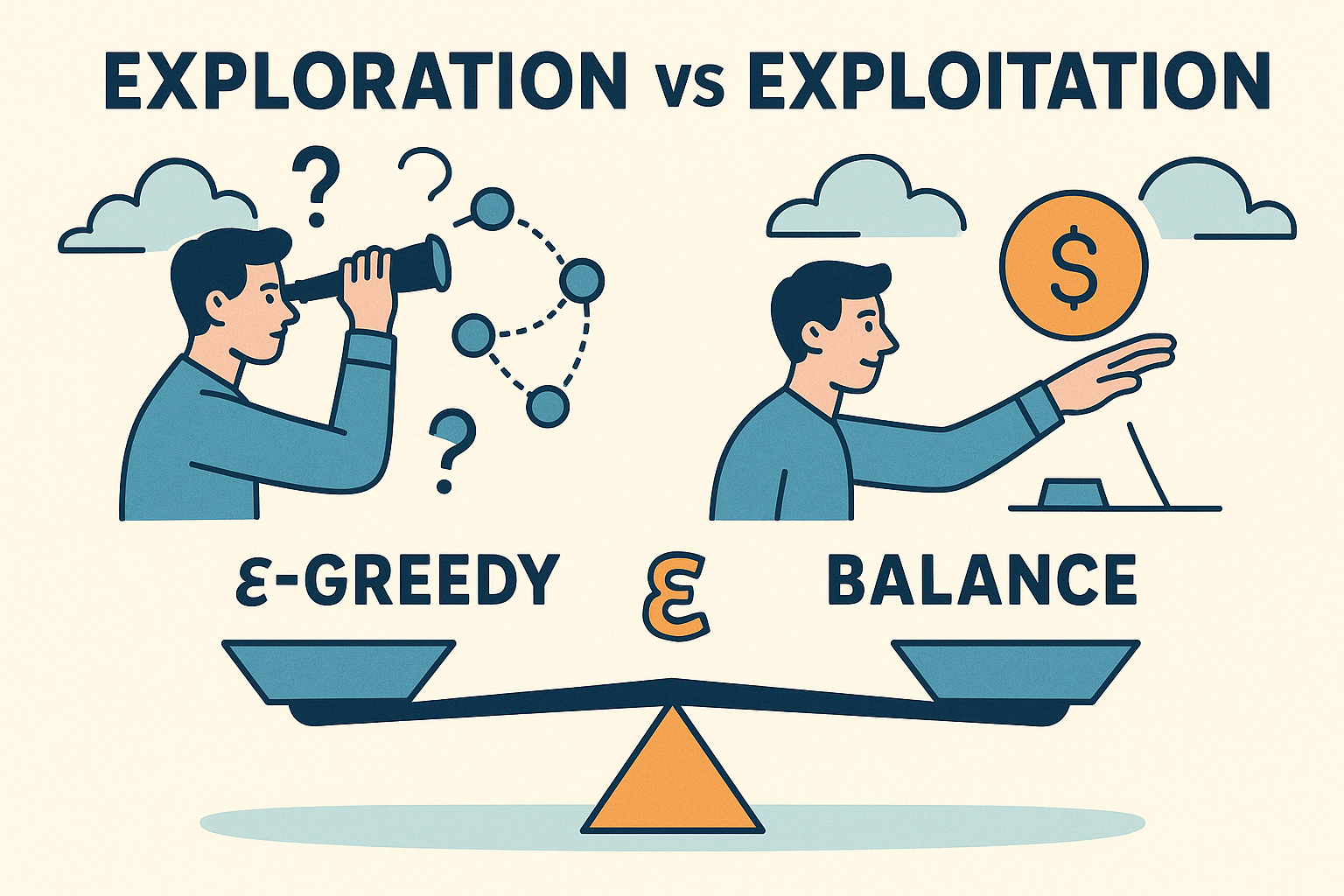
The exploration-exploitation dilemma: do you try new things (might be better) or stick with what works (guaranteed decent)?
Too little exploration: miss optimal actions Too much exploration: waste time on bad actions
Why exploration matters
Imagine a game where:
- Action A gives +1 reward always
- Action B gives +0 usually, but +100 rarely
Greedy agent tries B once, gets 0, never tries again. Misses the jackpot.
Interactive demo: Exploration Animation
Epsilon-greedy
Simplest approach:
- Probability ε: random action
- Probability 1-ε: best known action
def epsilon_greedy(Q, state, epsilon):
    if np.random.random() < epsilon:
        return np.random.randint(len(Q[state]))
    return np.argmax(Q[state])
Often decay ε over time:
epsilon = max(0.01, epsilon * 0.995) # decay each episode
Simple, works okay. But explores blindly - random actions might not be informative.
Boltzmann (softmax) exploration
Action probability proportional to Q-value:
$$P(a|s) = \frac{\exp(Q(s,a)/\tau)}{\sum_{a’}\exp(Q(s,a’)/\tau)}$$
τ (temperature) controls exploration:
- High τ: uniform distribution (explore)
- Low τ: concentrate on best (exploit)
- τ → 0: greedy
def boltzmann(Q, state, tau):
    q_values = Q[state]
    exp_q = np.exp(q_values / tau)
    probs = exp_q / exp_q.sum()
    return np.random.choice(len(q_values), p=probs)
Upper Confidence Bound (UCB)
Optimism in the face of uncertainty.
$$A_t = \arg\max_a \left[ Q_t(a) + c\sqrt{\frac{\ln t}{N_t(a)}} \right]$$
Bonus for uncertainty (less-tried actions). Explores systematically.
def ucb(Q, counts, t, c=2):
    ucb_values = Q + c * np.sqrt(np.log(t) / (counts + 1e-5))
    return np.argmax(ucb_values)
Provably optimal for multi-armed bandits.
Thompson Sampling
Bayesian approach:
- Maintain belief distribution over Q-values
- Sample from belief
- Act greedily on sample
# For Bernoulli bandits
def thompson_sampling(successes, failures):
    samples = [np.random.beta(s + 1, f + 1)
               for s, f in zip(successes, failures)]
    return np.argmax(samples)
Natural exploration: uncertain actions get sampled more.
Curiosity-driven exploration
For complex environments, add intrinsic reward for novelty.
Prediction error: Reward for visiting states the model predicts poorly.
$$r_i = |f(\phi(s), a) - \phi(s’)|^2$$
Where f is forward model, φ is feature extractor.
Count-based: Bonus inversely proportional to visit count.
$$r_i = \frac{\beta}{\sqrt{N(s)}}$$
Random Network Distillation (RND)
State-of-the-art curiosity:
- Fixed random network produces features
- Learned network predicts those features
- Prediction error = novelty
Novel states are hard to predict.
# Simplified
random_net = RandomNetwork()  # fixed
predictor = Predictor()  # trained

intrinsic_reward = ((random_net(state) - predictor(state)) ** 2).mean()
Comparison
| Method | Pros | Cons |
|---|---|---|
| ε-greedy | Simple | Blind exploration |
| Boltzmann | Smooth | Temperature tuning |
| UCB | Principled | Assumes stationarity |
| Thompson | Bayesian optimal | Needs prior |
| Curiosity | Sparse rewards | Can get distracted |
Exploration strategies unlocked! Star ML Animations and share this RL guide with others!